
Why Am I Not Losing Weight? 5 Ways Poor Sleep Could Be Making It Harder
You’re eating healthier. You’re exercising. Maybe you’re even tracking what you eat. And yet the scale will. Not. Move. So naturally you start wondering:
- Do I need to eat less?
- Exercise more?
- Cut carbs?
- Try harder?
But before you slash another 200 calories from your day, there’s another question I want you to ask:
How are you sleeping?
Because if you’ve found yourself Googling “Why am I not losing weight?”, there are many possible reasons worth discussing with your healthcare provider. But sleep is one piece of the puzzle that gets overlooked far too often. And once you understand why, you may look at that frustrating plateau very differently.
Sleep isn’t a magic weight-loss solution. Getting a good night of sleep tonight isn’t going to make pounds disappear by tomorrow morning. But poor sleep can make many of the behaviors and metabolic processes involved in weight management a whole lot harder.
Here are five reasons why.

1. Poor Sleep Can Make You Feel Hungrier
Here’s something I wish more people understood:
Your appetite isn’t controlled by willpower alone.
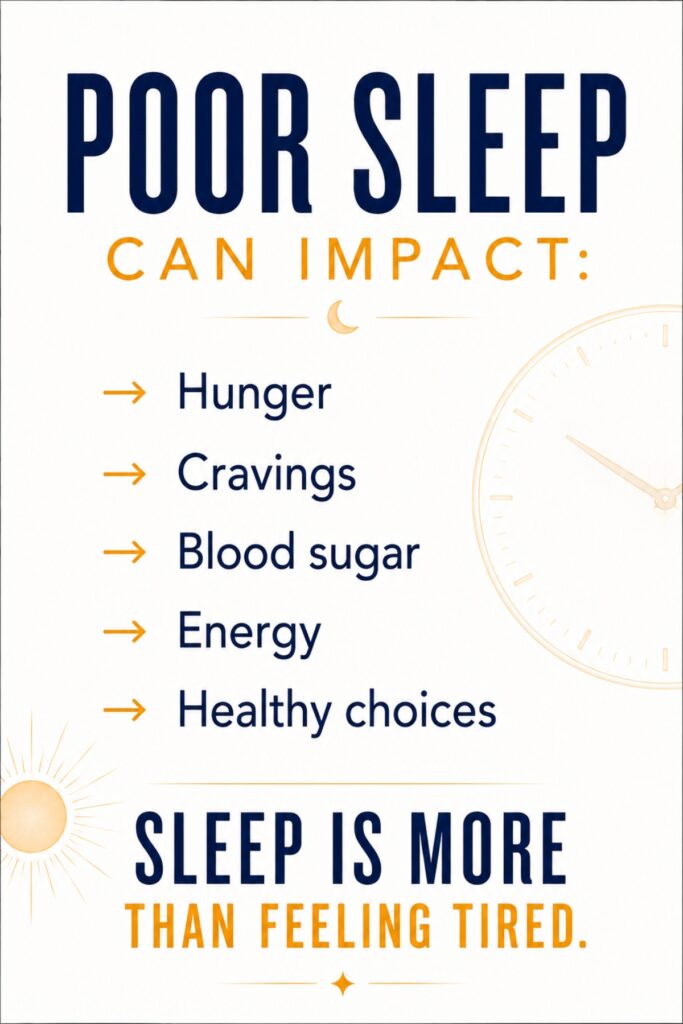
Your brain receives hormonal signals that help regulate hunger and fullness. When sleep is disrupted, those signals can be disrupted too, including hormones such as ghrelin and leptin. Translation? After a terrible night of sleep, you may notice you’re:
- Hungrier than usual
- Less satisfied after meals
- Thinking about food more often
- Reaching for quick-energy foods
Sound familiar? Maybe you ate the exact same breakfast yesterday and felt completely satisfied. But today—after being awake half the night—you’re rummaging through the pantry at 10 a.m. wondering why you suddenly have zero willpower.
You didn’t necessarily lose your motivation overnight.
Your body is tired. And it’s looking for energy. That’s a very different conversation than simply telling yourself to “be more disciplined.”
2. Lack of Sleep Can Make Cravings Feel Stronger
Have you ever noticed that after a great night of sleep, a balanced breakfast sounds perfectly fine…But after four hours of sleep? Suddenly you want the biggest pastry you can find. There’s a reason for that too. When you’re exhausted, sugary, high-carbohydrate and energy-dense foods can become much more appealing.
Your brain is looking for quick fuel. And this is one of the reasons weight loss can feel so frustrating when you’re chronically tired. You may spend all day thinking:
Why can’t I just stick with my plan?
But sometimes the better question is: Why is my body asking for so much energy right now?
That’s one of the biggest mindset shifts I explore in The Sleepdemic Solution. Instead of constantly fighting your body, start understanding what it is trying to tell you.
3. Sleep Can Affect Blood Sugar and Insulin Sensitivity
This is the connection most people don’t expect. Sleep and blood sugar are much more closely connected than many people realize.
Insulin helps move glucose from your bloodstream into your cells, where it can be used for energy. Even short periods of sleep restriction can reduce insulin sensitivity, making it harder for your body to handle glucose efficiently. That matters if you’re working on weight management. It matters if you’re managing insulin resistance or diabetes. And it matters if you simply want steadier energy throughout the day.
It’s also one reason you may occasionally notice a higher fasting blood sugar after a poor night of sleep—even when your food intake hasn’t changed dramatically. As a dietitian and diabetes educator, this is one of the connections I find especially important. We spend so much time talking about what we’re eating. But sometimes we need to look at what happened the night before, too.
4. Poor Sleep Can Make Your Entire Day Feel Harder
This may be the most relatable part of the sleep and weight loss connection. Because sleep doesn’t only affect what’s happening inside your body. It changes what your entire day feels like. Think about the day after a terrible night’s sleep. That morning workout suddenly feels much harder. Meal prep sounds a lot less appealing. You may rely on caffeine to push through the afternoon. You start snacking because you’re desperately looking for energy. Then 9 p.m. rolls around. Your body is exhausted. Your brain is somehow still wide awake. And the kitchen starts looking pretty tempting.
Then you wake up tired…And the cycle begins again.
One rough night isn’t the problem. It’s when that pattern becomes your normal. And that’s exactly why continually responding by eating less and pushing yourself harder may not be the answer.
5. Eating Less Isn’t Always the First Thing to Fix
This might be the biggest mindset shift I want you to take from this article. If you’re already eating reasonably well, exercising and repeatedly responding to stalled weight loss by cutting more food…You may be pulling the wrong lever.
Before I immediately think about cutting calories further, I want to know:
- Are your meals consistent?
- Are you eating enough protein and fiber?
- Is most of your food being pushed late into the evening?
- Is your blood sugar riding a roller coaster all day?
And importantly: Are you sleeping?
That’s why my approach in The Sleepdemic Solution focuses on building a rhythm around sleep, meal timing, balanced meals and blood sugar stability rather than simply asking you to restrict more. Because sometimes your body doesn’t need another fight.
It needs better signals.

What Can You Do Tonight?
Here’s the good news: You don’t have to completely overhaul your life tonight. In fact, please don’t. Start by giving your body a few clearer signals.
- Tomorrow morning: Get outside for some morning light.
- During the day: Try to eat meals at relatively consistent times.
- At meals: Build around protein, fiber and satisfying carbohydrates.
- At night: Avoid saving most of your food for the very end of the day.
- Before bed: Create a simple transition between your busy day and sleep.
Nothing extreme. Nothing that requires perfection. And instead of only asking: “What should I eat to lose weight?” Try asking: “What does my body need to function better?” That question may change the way you approach everything.
Want the Full 7-Day Plan?
The connection between sleep, hunger, blood sugar, cravings and metabolism is exactly why I wrote The Sleepdemic Solution.
Inside the book, I walk you through my complete SLEEP System and a practical 7-Day Reset designed to help you build a rhythm that supports better sleep, steadier energy, blood sugar and sustainable weight management.
Not another extreme plan. Not another list of foods you aren’t allowed to eat. A system you can actually use in real life.

Frequently Asked Questions
Poor sleep isn’t the only factor involved in body weight, but insufficient sleep can affect appetite, cravings, insulin sensitivity, energy and the behaviors that support weight management. That’s why sleep is one important piece to consider if you feel like you’re “doing everything right” but still struggling.
It can. Sleep deprivation can affect the hormonal signals involved in hunger and fullness, which may leave you feeling hungrier or less satisfied after eating.
Yes. Even short periods of sleep restriction can reduce insulin sensitivity, which may make it harder for the body to manage glucose efficiently.
It’s not an either/or situation. Nutrition, movement, sleep, stress and other health factors all work together. The goal is to stop treating sleep as though it has nothing to do with metabolism or weight.